


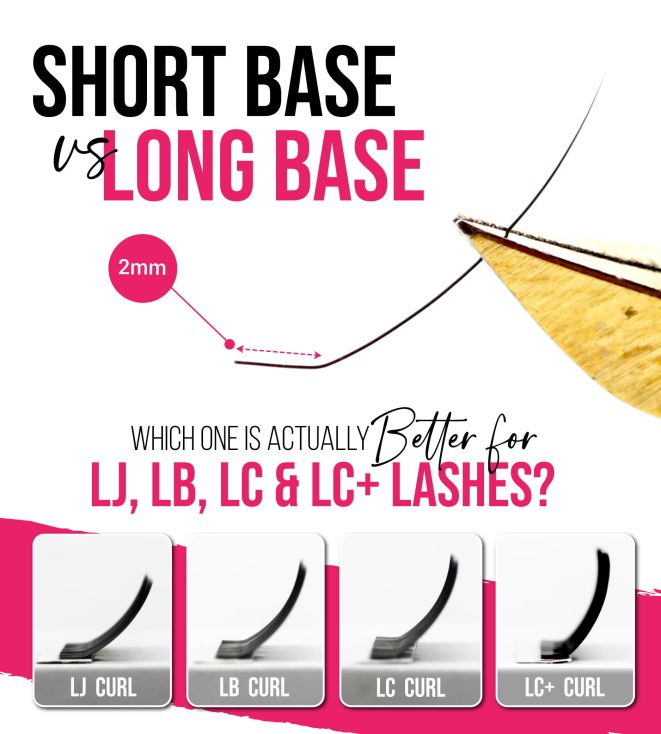
When choosing LJ, LB, LC, and LC+ lashes, lash artists usually focus on curl angle, thickness, and lash length. But another structural factor can directly influence how these special curls perform: base length. So, when it comes to Short Base or Long Base for L-Curls, which structure actually performs better?
In general, a shorter base preserves more fiber for curl development and visible lift, while a longer base provides more bonding area and greater retention potential. Each comes with a clear trade-off.
A 2mm base sits between these two ends of the spectrum, aiming to preserve enough lifting sections while still providing sufficient bonding support.
This guide to Short Base or Long Base for L-Curls compares 1.5mm, 2mm, 2.5mm, and 3mm bases, explains when each structure may be useful, and shows why CharmLash ultimately selected 2mm across LJ, LB, LC, and LC+.
What Does Base Length Mean in LJ, LB, LC & LC+ Lashes?
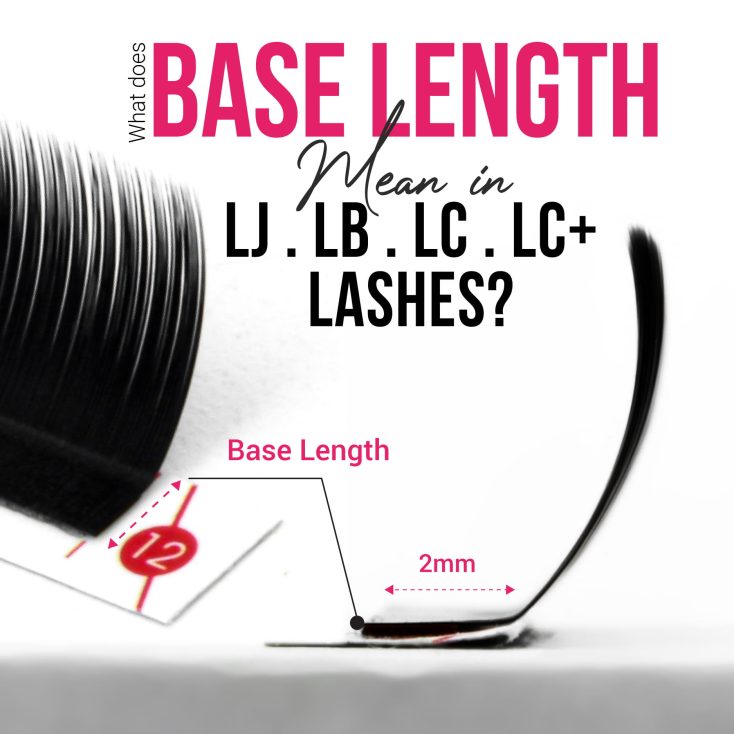
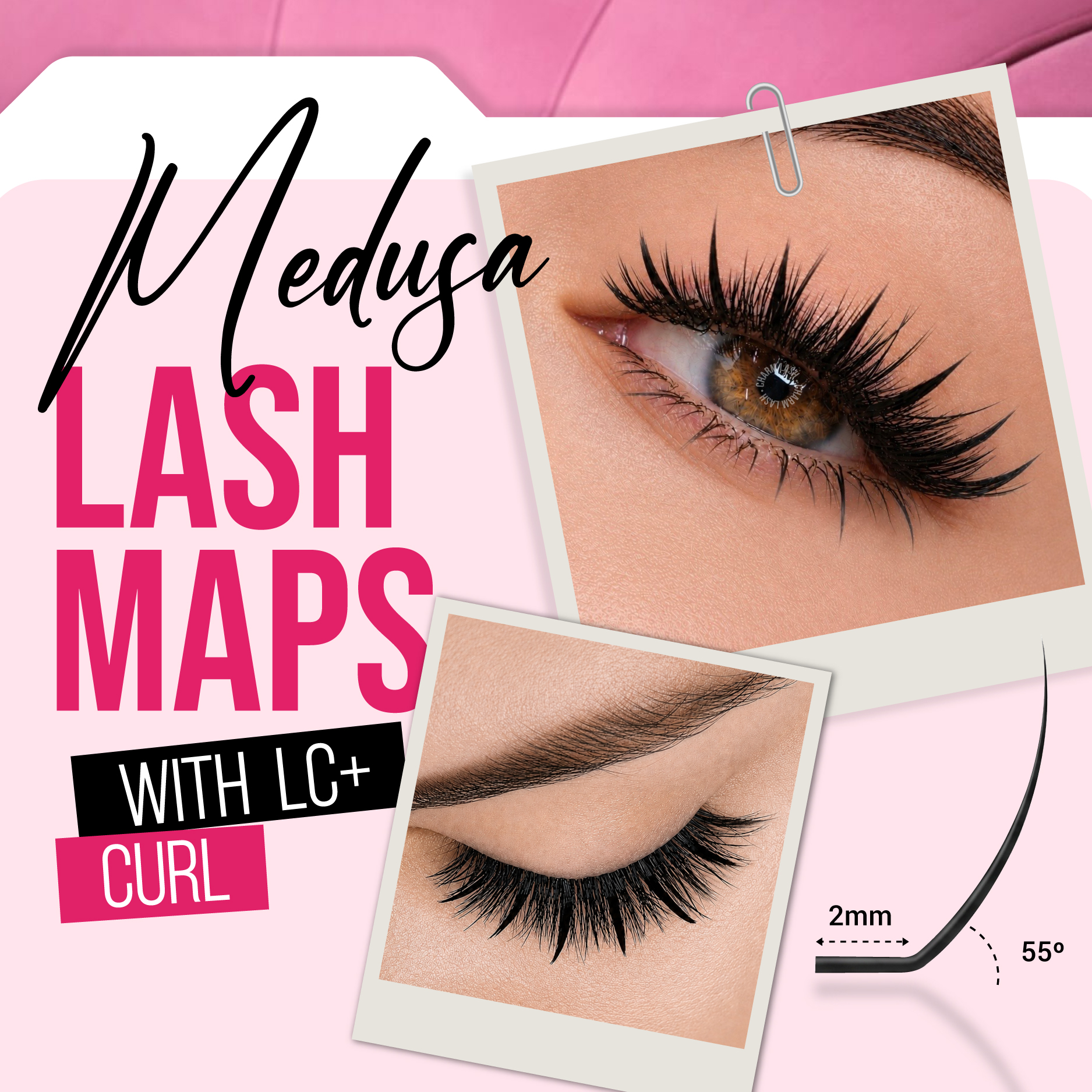
Base length is the relatively straight section at the bottom of the lash extension before the fiber transitions into its curved or lifting section.
The base mainly provides the contact area used to attach the extension to the natural lash, while the remaining section creates the curl shape and visible upward lift.
In simple terms:
- Base section → attachment
- Remaining curved section → curl shape and visible lift
Base length is different from total lash length. A 6mm, 10mm, or 14mm lash refers to the complete extension, while the base occupies only part of that total length.
When total lash length stays the same:
- Longer base → shorter remaining lifting section
- Shorter base → longer remaining lifting section
Increasing the base therefore does not make the lash longer. It simply uses more of the existing fiber before the curl begins. Base length also does not change the specified curl angle itself. The curl angle defines the intended lift. Base length determines how much room that lift has to express itself.
This simple structural difference is at the heart of the Short Base or Long Base for L-Curls decision, especially when working with shorter lash lengths.
This is why understanding Short Base or Long Base for L-Curls can help artists make more informed decisions when working with different natural lash directions and lash lengths.
What Changes as Base Length Changes?
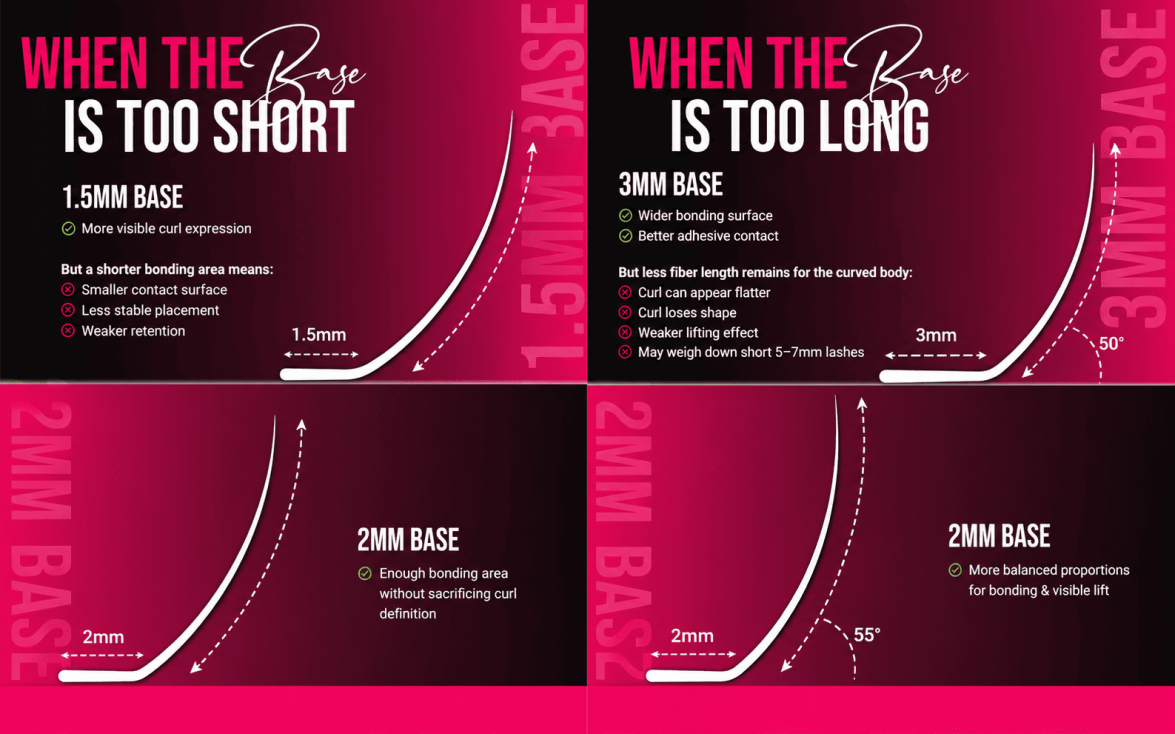
Changing base length shifts the balance between two performance priorities: lifting performance and bonding support.
When less fiber is used for the base, more remains available for the curl. The lifting transition can begin earlier, helping the lash maintain stronger visible lift and clearer curl expression. The trade-off is a smaller attachment area and a greater need for precise placement.
As the base becomes longer, the artist gains more contact area with the natural lash and greater placement tolerance. However, more of the extension is used before the curl begins, leaving less fiber available for the lifting section.
The relationship can be summarized as:
- Less base → more available curl section → stronger visible lift → smaller bonding area
- More base → more bonding area → less available curl section → reduced visible lift
When evaluating Short Base or Long Base for L-Curls, artists should look at this relationship as a balance between the space needed for attachment and the fiber needed to create visible lift.
The goal is therefore not simply to maximize one side, but to choose the structure that matches the client’s priorities.
Short Base or Long Base for L-Curls: Comparing 1.5mm, 2mm, 2.5mm & 3mm Bases
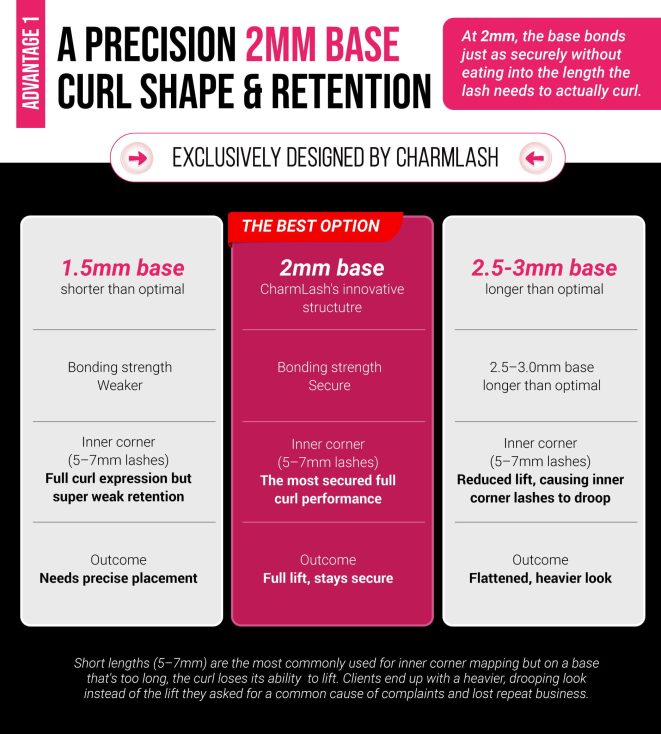
When comparing Short Base or Long Base for L-Curls, these four base lengths show how even a small structural change can shift the balance between curl expression, bonding support, and application control.
1.5mm Base
A 1.5mm base leaves the most fiber available for the lifting section. This helps the curl transition earlier and preserves stronger visible lift and curl definition.
Its main trade-off is the smaller bonding zone. With less surface available for attachment, placement needs to be more precise and offers less tolerance for application errors.
Main strength: maximum available curl space
Main trade-off: smaller bonding area and higher application demand
2mm Base
A 2mm base provides more usable bonding area than 1.5mm while still leaving substantial fiber available for the lifting section.
Rather than maximizing lift or bonding alone, it sits between the two priorities and maintains a more balanced structure.
Main strength: balance between lift and bonding support
Main trade-off: does not maximize either extreme
2.5mm Base
At 2.5mm, more of the extension is allocated to the straight bonding section. This creates more contact area and greater placement tolerance.
However, the remaining lifting section becomes shorter, so visible curl expression can be reduced compared with 1.5mm or 2mm.
Main strength: larger bonding area and higher retention potential
Main trade-off: reduced available lifting section
3mm Base
A 3mm base provides the largest bonding section of the four. This offers the greatest attachment area and can make placement more forgiving.
At the same time, it leaves the least fiber available for visible curl development, making the trade-off in lifting performance the most pronounced.
Main strength: largest bonding section
Main trade-off: greatest reduction in available curl space
Why Base Length Matters More on Short Lashes
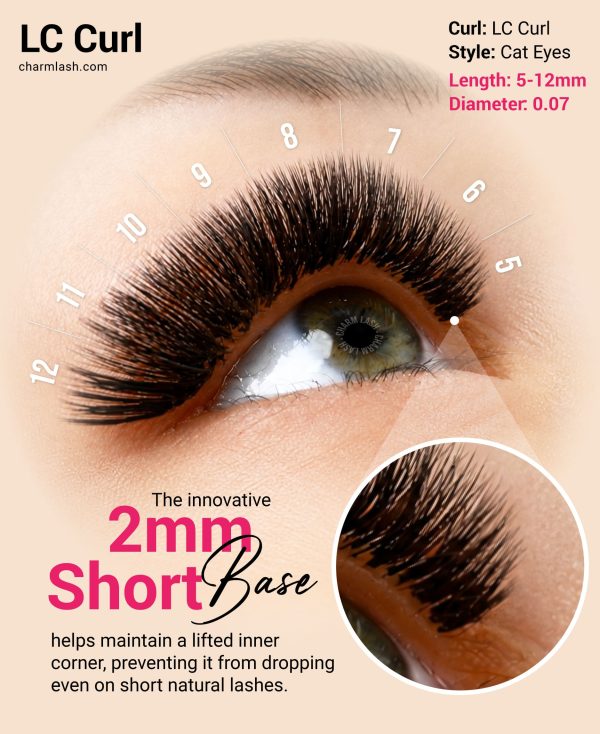
Base length has a stronger visual impact as total lash length decreases.
On a 5–7mm lash, a 2.5mm or 3mm base occupies a large proportion of the total extension. Less fiber remains for the lifting section, so the curl can begin later and appear flatter or less defined.
The same base length has less proportional impact on longer lashes because more fiber remains after the bonding section.
This is particularly important for:
- inner-corner applications;
- extreme cat-eye and fox-eye mappings;
- downward-growing lashes;
- hooded eyes;
- monolids;
- clients requiring stronger corrective lift.
The shorter the lash, the more every millimeter of base affects the final lifting shape.
For this reason, the choice between Short Base or Long Base for L-Curls becomes particularly noticeable when working with 5–7mm lashes, especially around the inner corners.
Short Base or Long Base – Which One Is Actually Better?
The answer depends on what the client needs most. When comparing Short Base or Long Base for L-Curls, artists should consider the natural lash direction, desired lifting effect, lash length, and the importance of bonding support.
| 1.5mm Base | 2.5–3mm Base | |
| Best for | Strong corrective lift | Retention-focused applications |
| Eye / lash condition | Downward lashes, drooping inner corners, hooded or monolid eyes | Natural lashes already showing sufficient upward direction |
| Main advantage | Stronger curl expression | Wider bonding area |
| Main trade-off | Smaller bonding zone | Reduced lifting performance |
| Artist consideration | Requires more precise placement | More forgiving during attachment |
A 1.5mm base becomes useful when corrective lift matters more than maximizing retention potential. This may include strongly downward-growing lashes or pronounced inner-corner drooping, where preserving the lifting section has a greater visual impact.
There is also a separate practical limitation. Within CharmLash’s current offering, 1.5mm is available only in selected Camellia constructions, with fewer options in materials, colors, and thicknesses. This does not change its structural performance, but it can reduce creative flexibility for artists.
A 2.5mm or 3mm base becomes more relevant when bonding and retention potential are the higher priorities and the client’s natural lashes already have enough upward direction. In these cases, some reduction in curl expression may have less impact on the finished result.
The best base is not necessarily the shortest or the longest. It is the one that provides enough attachment space without sacrificing the lifting performance the client actually needs.
How Base Length Interacts With LJ, LB, LC & LC+
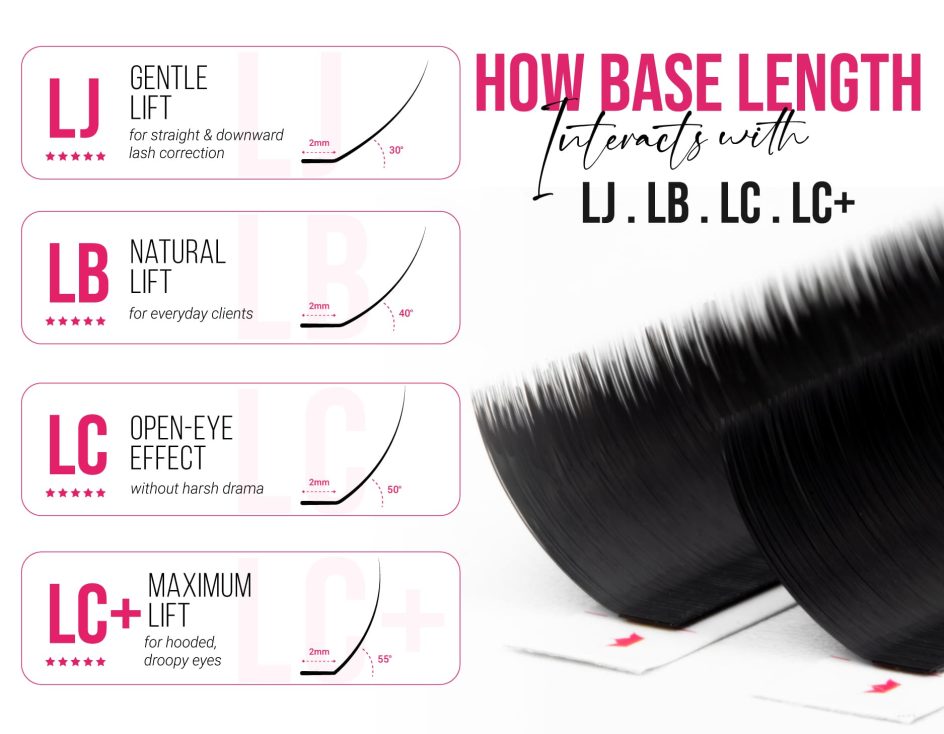
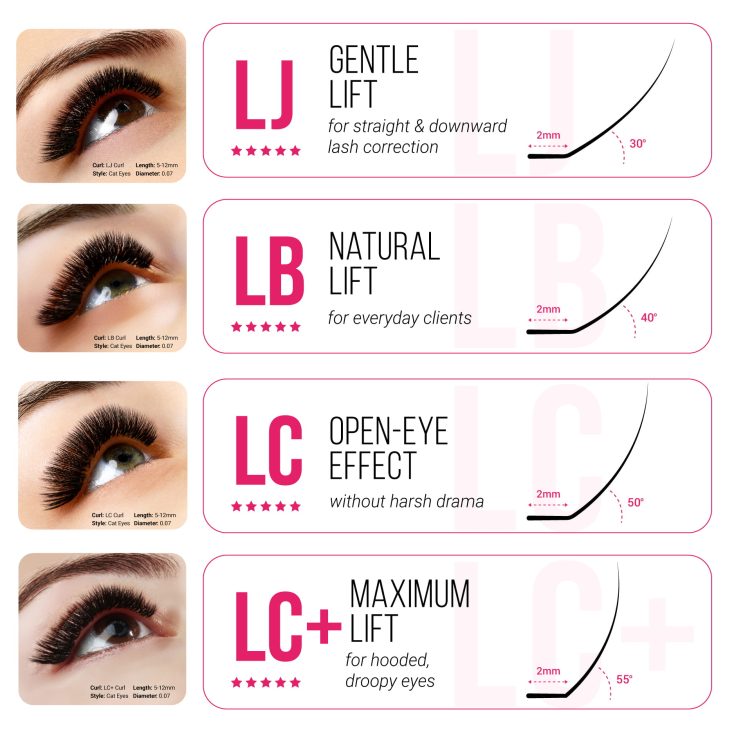
CharmLash uses the same 2mm base across four progressive lifting angles:
- LJ – 30°: gentlest lift
- LB – 40°: soft lift
- LC – 50°: defined lift
- LC+ – 55°: strongest lift
The base and curl angle therefore play different roles.
The base provides the attachment foundation, while the curl angle determines the intended level of lift. Keeping the base consistent allows the progression from LJ to LC+ to come from the engineered curl geometry rather than from changes in base length.
The base provides the foundation. The angle creates the lift progression.
How to Evaluate Base Length When Choosing LJ, LB, LC or LC+ Lashes
Three factors matter most.
1. Natural Lashes and Eye Shape
Downward lashes, drooping inner corners, hooded eyes, and monolids generally require stronger corrective lift, making shorter or balanced bases more relevant. When natural lashes already have sufficient upward direction, a larger bonding section can be considered when retention is the priority.
2. Artist Skill
A 1.5mm base provides less room for placement error and requires greater precision. Less experienced artists may find a 2mm or larger base easier to control.
3. Lash Map
Maps using 5–7mm lengths, including some extreme cat-eye or fox-eye designs, require enough remaining fiber for the curl to develop. Maps starting around 8mm or longer provide greater flexibility.
In short: For artists wondering about a short base or long base for L-Curls, the decision should therefore start with the desired correction and lash map rather than simply choosing the shortest or longest option.
Why CharmLash Chose 2mm
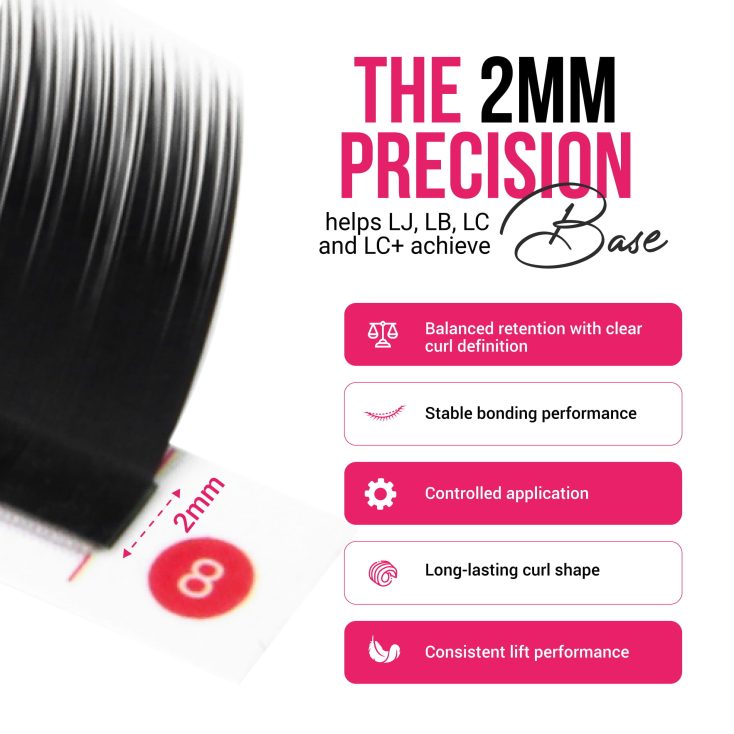
CharmLash evaluated the trade-offs across the 1.5–3mm range when developing LJ, LB, LC, and LC+.
A 1.5mm base preserves strong curl expression but provides a smaller bonding zone and requires more precise application.
A 2.5mm or 3mm base provides more bonding area and greater retention potential, but leaves less fiber available for visible lift especially on shorter lengths.
CharmLash therefore selected 2mm as the structural middle ground. For artists comparing Short Base or Long Base for L-Curls, the 2mm structure offers a practical middle ground between the stronger lift of a shorter base and the larger bonding area of a longer base.
Compared with 1.5mm, it provides more usable bonding area and greater attachment stability. Compared with 2.5mm and 3mm, it preserves more fiber for the lifting section.
This allows one consistent base to support LJ 30°, LB 40°, LC 50°, and LC+ 55° across lengths from 5mm to 18mm.
CharmLash chose 2mm not to maximize lift or retention alone, but to optimize curl performance and bonding stability together.
Conclusion: The Right Base Is About Balance, Not Length Alone
As this Short Base or Long Base for L-Curls guide shows, each base shifts the balance between curl expression, bonding area, application control, and retention potential.
1.5mm favors lift and curl expression.
2.5 – 3mm favors bonding area and retention potential.
2mm sits between the two.
For CharmLash’s LJ, LB, LC, and LC+ system, 2mm provides enough bonding support while preserving sufficient fiber for the intended curl shape and lifting performance.
Ultimately, the right base length for L-curls depends on the balance between attachment support and lifting performance. The goal is not simply to choose a shorter or longer base, but to select a structure that gives the lash enough foundation to stay and enough fiber to lift.
👉 Explore more:
Hong Kong, Here We Come: CharmLash at Cosmoprof Asia Hong Kong 2026
Medusa Lash Map with LC+ Curl: A Creative Mapping Guide for Lash Artists
DeepCut Laser Lash Technology: The Next Evolution of Laser-Cut Lash Extensions
Instagram: CharmLashvn
Tiktok: CharmLash23